
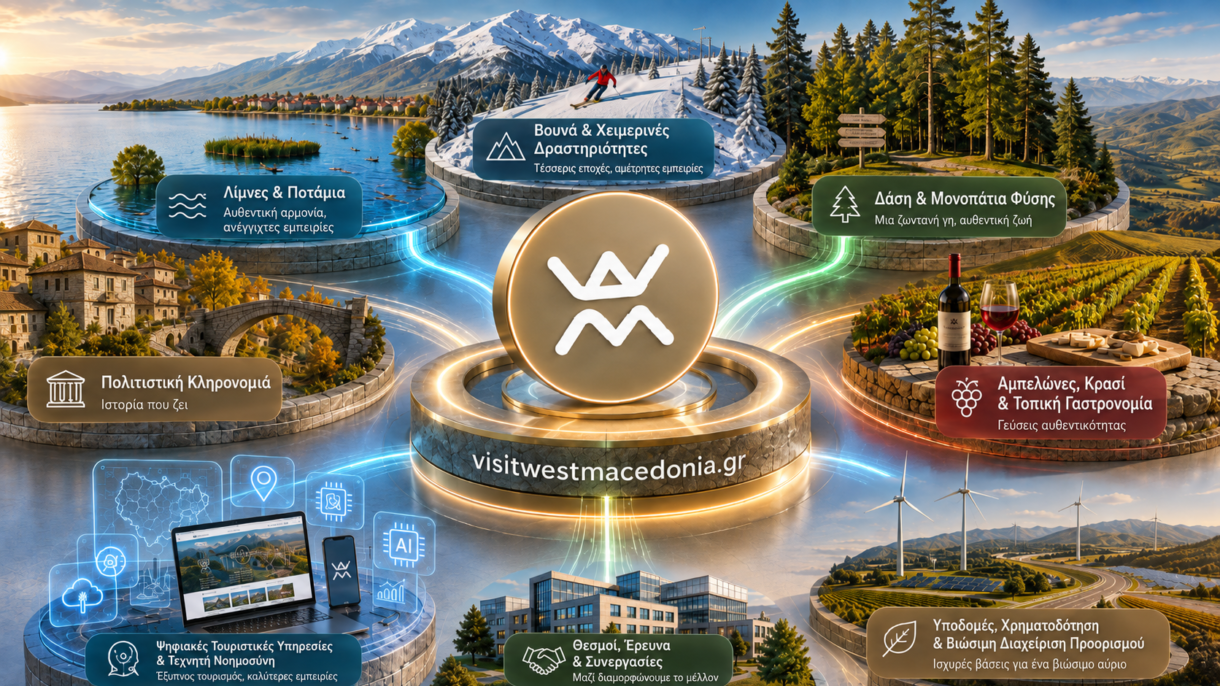

A new digital infrastructure and an opportunity to align Western Macedonia’s development initiatives
The presentation of Western Macedonia’s integrated tourism product on 29 August 2026 marks a substantive shift in how the Region organises, manages and communicates the destination.
At its centre is the new Visit West Macedonia digital gateway, supported by a renewed destination identity, audiovisual assets and printed tourism maps.
 Visit West Macedonia
This is not simply a modern promotional website. It is an organised digital infrastructure for collecting, classifying and activating the region’s tourism assets, with a clear destination-management orientation and a practical focus on the visitor journey.
The breadth of its content and the functional integration of different tools provide, for the first time at this scale, a shared point of reference for Western Macedonia’s places, experiences, infrastructure and future development initiatives.
From geography to an organised destination
Western Macedonia possesses substantial natural, cultural, historical and productive assets. The principal weakness was never a shortage of places worth visiting, but their fragmented presentation and their limited integration into complete visitor experiences.
The new platform presents the Regional Units of Grevena, Kastoria, Kozani and Florina as a coherent whole. It also highlights places with distinct identities, such as Siatista, connecting architecture, history, gastronomy and local production.
At the same time, it positions Western Macedonia as a destination for autumn, winter, spring and summer. This is developmentally significant because it supports a longer tourism season and distributes activity across more places and more months of the year.
Organising the destination around thematic experiences, including lakes, snow and winter activities, nature, gastronomy, wine and viticultural heritage and wellness, allows visitors to design a trip around their interests rather than geography alone.
The structural change is clear: the stand-alone attraction is now positioned within a network of places, routes and experiences.
From information to trip planning
The platform does more than display content. Its interactive map supports spatial exploration of points of interest, while the AI Travel Planner uses artificial intelligence to generate suggestions based on the visitor’s available time and preferences.
The tourist guide, together with the sections on transportation, useful phone numbers and travelling with pets, addresses practical needs that are often absent from conventional destination-promotion websites.
The events calendar, the tourism newsletter and the visitor survey create additional channels for continuous communication and the gradual collection of data on visitor interests and satisfaction.
Artificial intelligence therefore has a defined operational role: it reduces search time and combines information into personalised itineraries. Its long-term value, however, will depend on data quality and continuous updating. Technology does not replace evidence, it activates it.
From diagnosis to implementation
The Greek National Tourism Organisation’s Tourism Development Study for Central and Western Macedonia identified fragmented promotion, limited use of new technologies, weak coordination and the absence of integrated tourism products.
Among other measures, it proposed collaborative networks, thematic routes, systematic use of information technologies, data collection and evaluation, visitor-satisfaction measurement and stronger links between tourism, culture, local production, education and sport.
The Western Macedonia Tourism Promotion Programme for 2026 follows the same direction, setting the objective of a unified, recognisable and year-round destination.
Visit West Macedonia is the first integrated operational response, at this scale, to these long-standing needs. Its significance lies in the fact that it does not add another isolated promotional action. It creates a foundation on which separate development initiatives can converge and acquire continuity.
Bringing knowledge, projects and funding together
The platform’s strategic value lies in its capacity to function as a shared digital backbone for projects implemented by different programmes and institutions.
For example, the Integrated Territorial Investment for the Lakes and Rivers of Western Macedonia and the Grevena–Kozani Geopark Integrated Territorial Investment can generate routes, environmental datasets, points of interest and digital assets that feed into the shared destination infrastructure.
The Living Lab Hubs and the Western Macedonia Innovation Zone, including the AgroWine Living Lab, offer a comparable opportunity by connecting agri-food, wine, lakes, mountain areas and smart technologies with fields of direct tourism relevance.
The Just Transition Programme 2021–2027, Ministry of Tourism instruments for mountain tourism, agritourism and gastronomy, LEADER and Interreg actions, and initiatives in culture, entrepreneurship and innovation can operate in complementary ways. The critical requirement is that their outputs should not be dispersed across disconnected websites and applications, but should add documented content, data and new functions to the shared infrastructure.
Within the same framework, distinct roles can be played by the Tourism Organisation of Western Macedonia and the other institutional contributors listed on the official gateway, the Regional Development Fund of Western Macedonia, ANKO Western Macedonia, the University of Western Macedonia, municipalities, chambers, development and research organisations, and cultural, environmental and professional bodies. These institutions are not collectively presented as the platform’s creators. They constitute the wider ecosystem of knowledge and implementation that can sustain and enrich it.
The Western Macedonia Development Studies Repository is also an important evidence base, hosting the studies submitted for inclusion over time and organising them by institution and sector.
Bringing these resources together does not imply administrative centralisation or a restriction of local initiative. It means shared standards, interoperability and the preservation of knowledge produced with public funding.
From this point onward, every funded intervention with a tourism, cultural, productive or environmental dimension should ideally specify from the outset what content and data it will contribute, which existing actions it will connect with, how its outputs will be updated after funding ends, and which indicators will be used to assess its actual impact.
Every new study, route, event, infrastructure project or digital product should leave a permanent and reusable footprint and increase the destination’s overall value.
A shared reference point for what comes next
Western Macedonia now has a credible foundation to which future infrastructure, funding, studies, cultural actions, business initiatives and international-promotion activities can be connected.
Each new programme need not start from the beginning or construct yet another isolated digital product. A shared infrastructure now exists that can receive, organise and multiply the value of every new initiative.
The presentation by Vice-Governor for Tourism, Culture and Environment Polytymi Farmaki was excellent: structured, clear and substantive, grounded in knowledge of the subject and in a precise understanding of the continuity required. What was presented was not simply a new website, but the potential to establish a modern regional system for tourism development.
The contribution of Western Macedonia Regional Governor Giorgos Amanatidis connected the initiative to the region’s emerging productive model.
Its success, however, belongs to the team as a whole and to everyone who worked together, in different roles, to create and support this common undertaking. The region now has not only a credible technical foundation, but also the human capacity to develop it with continuity, expertise, cooperation, local knowledge and purpose.
The next step is not simply to add more actions. It is to establish a shared direction, connect each new intervention to what has already been created, and convert temporary funding into permanent development capacity.
If this direction is maintained, Visit West Macedonia can become an example of a shared reference point where knowledge becomes planning, planning becomes cooperation, and funding is converted into measurable and lasting outcomes.
A shared place where every new study, route, infrastructure project and experience adds value to what came before rather than operating in isolation, where technology serves the knowledge and character of the place, and where collective creativity turns Western Macedonia’s potential into a coherent, long-term development pathway.