


The approval of the Living Labs does not close a process. It opens a test of cooperation that the participating institutions themselves will ultimately determine.
On 21 August 2026, the Operation for the development and operation of six Living Labs and the Innovation Zone of Western Macedonia was approved under the Just Development Transition Programme 2021-2027, with a total budget of 7,000,000 euro and the Regional Development Fund of Western Macedonia as beneficiary. Behind this single line lie twelve sub-projects, five contracting beneficiaries, ten institutions and eight months of appraisal.
The figures, however, do not tell the essential story. What exactly is being built, why it is being built this way, and what will determine its success.
The diagnosis: the gap was never about funding, it was about intermediation
Western Macedonia has never lacked programmes. What it lacked—and still lacks—is something harder: intermediary structures that translate scientific knowledge into a solution for a specific business, within a specific timeframe and with a measurable result. The literature describes this as an absorptive capacity deficit. A small business may understand the technology and still lack the time, capital or risk tolerance to test it on its own.
Between a research result and commercial application lies a maturity gap, broadly from Technology Readiness Level 4 to 7, which conventional funding instruments do not cover. Research funding stops earlier and investment support starts later. In between, innovation does not die for lack of ideas. It dies for lack of testing infrastructure. This is precisely the gap the Living Labs are designed to bridge.
There is a second, equally uncomfortable observation. Where initiatives existed, they were scattered. Each institution worked with its own logic, tools and data. The result was not zero, but it added up nowhere. A region in transition cannot afford efforts that do not add up.
Innovation Zone and Strategic Hub are not the same thing
The two terms are often used as synonyms. They are not, and the distinction has practical consequences.
The Strategic Hub is the wider whole, the operational framework within which the Region designs, coordinates and monitors its development ecosystem: smart specialisation strategy, business support mechanisms, data, observatories, one-stop structures. It is the way the Region thinks as a system.
The Innovation Zone is a subsystem of that framework. It is the core of the physical and institutionally established intervention, where innovation acquires infrastructure, space, equipment and operating rules. The Living Labs, in turn, are the operational core of the Zone, the point where the system touches an actual business.
In simple terms: the Strategic Hub thinks, the Innovation Zone provides the setting, and the Living Labs do the work. Their operation is a core component of the Strategic Hub, not an annex to it. The Hub also has value in its own right: every four months it brings the strategic institutions to the same table and coordinates projects independently of the Labs. Without the Labs, however, it coordinates without delivering. It lacks the mechanism through which cooperation reaches the business.
Why Living Labs and not some other instrument
A Living Lab is neither a laboratory in the academic sense nor a business incubator. It is an open innovation methodology applied in real-life conditions, with the end user as co-creator rather than passive recipient. It operates on the quadruple helix model, bringing the scientific community, businesses, public administration and civil society to the same table. It also has a feature that sets it apart from every other instrument: experimentation happens where the problem actually exists. In a field, in a greenhouse, in an energy installation, in a building, on a lake, in a mountain settlement.
The governing principle is known as test before invest. A business tests before committing capital. Public resources therefore reduce private risk, which is, both in theory and in practice, the most efficient way to mobilise private investment in a region with a low tolerance for risk.
The six labs were not chosen at random. They cover the sectors where Western Macedonia has both a problem and a comparative advantage: clean technologies and energy, agrifood and wine, mountain areas, lakes, resilience of critical and energy infrastructure, and smart technologies.
The architecture: why a central hub and not six parallel projects
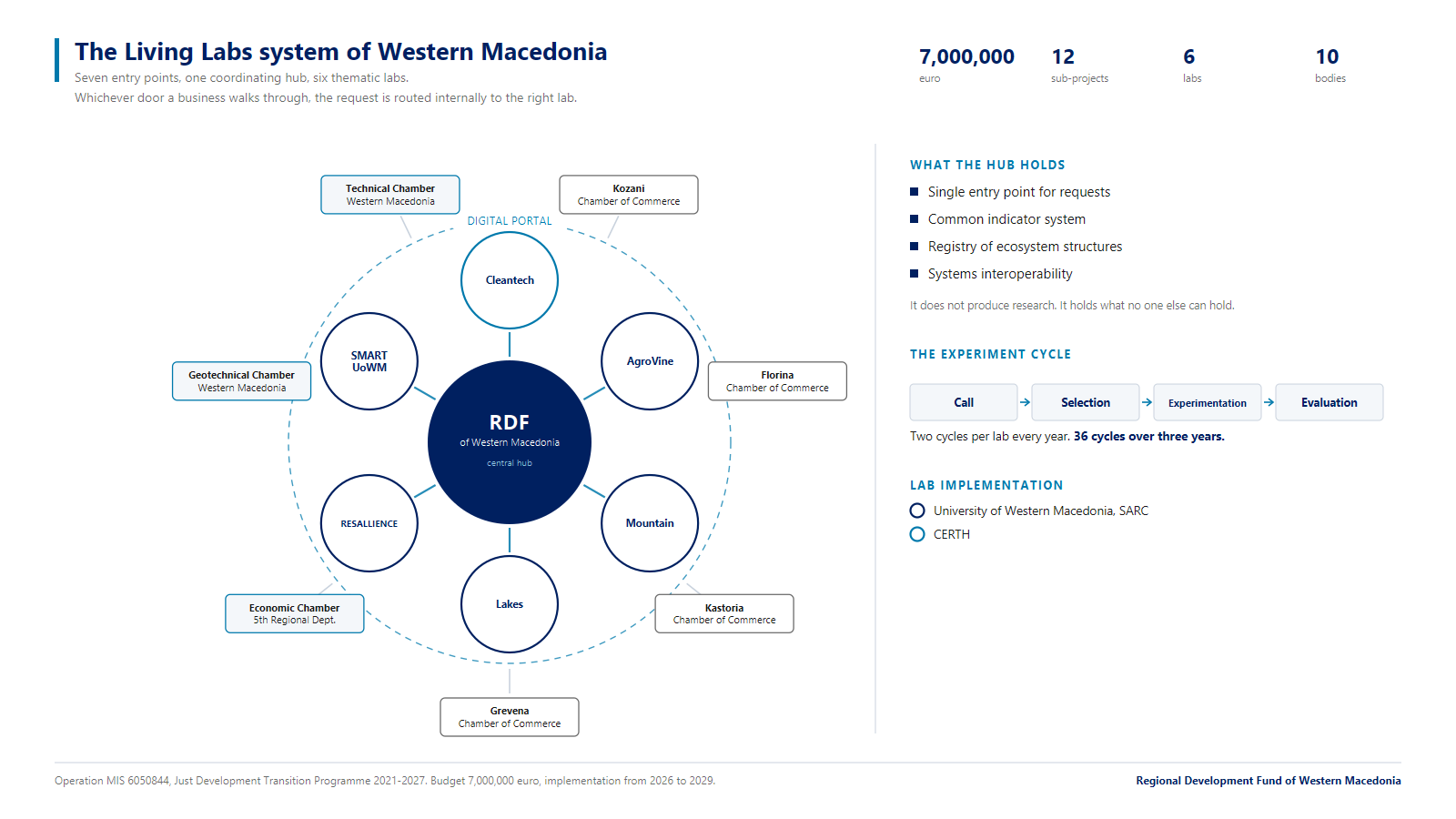
The architecture was the proposal’s most important design decision. Six standalone labs would have been administratively simpler and operationally useless, because they would have reproduced exactly the fragmentation the Operation is intended to overcome.
A hub-and-spoke structure was chosen. The hub—the Regional Development Fund—does not produce research. It holds four functions that no other body can hold: the single entry point for requests, the common indicator system, the registry of ecosystem structures and system interoperability. The spokes—the thematic labs—provide the service where their expertise lies.
The difference becomes clear in practice. A business in Kastoria with a food-quality problem does not need to know which lab does what. It only needs to enter through one door. The internationally recognised no wrong door principle is not a slogan. It is an operational requirement with direct design consequences.
Why coordination was assigned to the Regional Development Fund
Coordinating a scheme of ten institutions is not assigned on the basis of availability. It depends on institutional capacity and trust. Both exist here, and on a stronger footing than in any previous period.
The Regional Development Fund of Western Macedonia now has a Directorate. Under its new Internal Organisation Charter, it has a distinct organisational structure, clear responsibilities and the capacity to exercise a strategic rather than merely administrative role. In parallel, a decision of the Regional Council of Western Macedonia designated it as coordinator of the Innovation Zone and the Strategic Hub. This role did not arise from the Operation; it already existed and provides the Operation with institutional grounding.
What matters most, however, is not the organisation chart. It is the trust of the partners. Five institutions with autonomous governance, equal institutional standing and their own priorities agreed to sign a programme agreement with the Regional Development Fund as lead partner. That is not a given in any region of the country, and it cannot be created by a document.
Coordination also creates an internal obligation. The Fund must make effective use of all its staff, with clear responsibilities, no overlaps and no dependence on individual people. This is not merely an internal organisational issue. It is the condition that allows the hub to manage twelve sub-projects at the same time without itself becoming the system’s bottleneck.
Those staff also need to connect, as far as possible, with every relevant structure in Western Macedonia: Regional authority services, chambers, research institutions, development bodies and business-support mechanisms. A hub that is not connected is not a hub.
Who does what, and above all what each body does not do
Clear boundaries do not obstruct cooperation. They make it possible. In the approved Technical File, roles and resources are allocated as follows.
| Body | Resources | Responsibility |
|---|---|---|
| Regional Development Fund of Western Macedonia | €115,600 (SP 12) | Strategic coordination and horizontal support. Central reception and triage of requests, unified indicator system, registry of structures, coordination of interoperability, management of the Operation and of the programme agreement, communication for the whole. It does not produce research and does not substitute for any partner in its own field. |
| University of Western Macedonia, Special Account for Research Funds | €3,784,124.40 (SP 3 to 9) | Scientific pillar of five labs, covering agrifood and wine, mountain areas, lakes, infrastructure resilience and smart technologies. Procurement of laboratory equipment and development of the Digital Portal. It provides infrastructure, methodology and staff, without taking on strategic coordination. |
| Centre for Research and Technology Hellas, CERTH | €2,862,275.60 (SP 1 and 2) | Research pillar of the clean technologies lab. Equipment, unified platform, dissemination and exploitation of the infrastructure. It brings national and European experience into a regional scheme, which is its substantive added value. |
| Chambers of Commerce of Western Macedonia: Kozani, Florina, Kastoria and Grevena | €136,000 (SP 10) | The front line. A network of local service points with a reception officer in each chamber. Information, mobilisation of businesses, first-line advisory support, routing of requests. They do not conduct research and do not run standalone publicity actions, since communication is horizontal and unified. |
| Professional chambers: Technical Chamber, Geotechnical Chamber and Economic Chamber of Western Macedonia | €102,000 (SP 11) | Technical, geotechnical and economic expertise, mentoring, maturation advisory support. They are the link that translates a research result into a study, a permit, a specification and an investment plan, that is, into something that can actually be implemented. |
Two points are often overlooked. First, the Kozani Chamber and the Technical Chamber of Western Macedonia act as beneficiaries on behalf of all the commercial chambers and all the professional chambers respectively. They submit, manage and account for the sub-projects, while resources are shared and actions implemented by all. Second, the chambers’ allocations may look small—238,000 euro in total, or 3.4% of the Operation—but they are the mechanism that will determine whether the remaining 6.7 million reaches an actual recipient.
Connectivity works on four levels, not one
Connectivity is usually understood as a technical matter. In practice, it operates at four distinct levels of different criticality. Two are binding—the institutional level and the data and knowledge level—and without them there is no unified Operation. Two can degrade gracefully—the operational and digital levels. If the Digital Portal is delayed, service continues through a request protocol and the chambers’ reception points. Speed and traceability are reduced, but the service remains operational. The design therefore provides an alternative route for every degradable level.
Institutional level — binding. A signed programme agreement between all participating institutions safeguards their cooperation. It defines roles, resource allocation, deliverables, monitoring bodies and mutual obligations, with the Regional Development Fund as lead partner. It is not a declaration of intent. It is subject to pre-contractual review by the Hellenic Court of Audit and is legally binding.
Operational level — degradable. Every business request receives a unique identifier, is assigned to a case manager and is routed to the appropriate provider—a Living Lab, a chamber or another structure—with progress tracking, an action history, agreed service levels and an escalation mechanism. This is how the no wrong door principle becomes a procedure rather than an aspiration.
Digital level — degradable. The Living Labs Digital Portal is not a website. It is a coordination system: service and equipment bookings, access to data, matchmaking, user management and assessment of business innovation maturity. Sub-projects 2, 6, 7, 8 and 9 have received a Harmonisation Certificate from the General Secretariat of Information Systems and Digital Governance. They are therefore required to speak the language of the Greek digital state, not one of their own.
Data and knowledge level — binding. Common indicators, a unified methodology for valuing the service provided, a shared Registry of Structures, and links to the Regional Smart Specialisation Strategy and to the information systems of the Region, the University and CERTH. Without this level, the end of the three-year period would produce six success narratives and no common measurement.
The mechanism that will decide everything: the experiment cycles
The heart of the operation is not the equipment but the experiment cycles. Two are planned per year in each thematic lab, following a standard four-stage process: call, selection, experimentation, evaluation. Each open call defines the required technology readiness level on entry and, where appropriate, on exit. Participants co-design the experimental plan, gain access to equipment and data, and the cycle closes with an indicator-based evaluation and a public presentation of results.
Six labs, two cycles each and three years of operation produce thirty-six experiment cycles. The target of 88 supported businesses, including 44 new ones, amounts to fewer than three businesses per cycle. This must be stated plainly. Success has two levels. The first is contractual and non-negotiable: 88 supported businesses and 44 new ones. It is the floor, not the ceiling. The second is developmental, and it determines whether the effort was worthwhile: the value generated through the operation of the Labs should exceed the 7,000,000 euro budget. A single business that multiplies its turnover with the support of the Living Labs may justify the undertaking. Compliance with the indicators alone does not.
Why this was an exceptionally difficult proposal
This is not said as a complaint, but to show the complexity now being handed over for implementation.
The proposal brought together ten institutions with different legal forms—public- and private-law entities, a university and a research centre—and organised them into twelve sub-projects with a coherent logic. For every sub-project, reasonable cost and in-house implementation capacity were documented through complete Cost Analysis Forms and Technical Annexes, rewritten repeatedly until they could withstand scrutiny.
Potential overlap with other operations in the region, including SYNERGiNN, DigiAgriFood and Smart Lab Ptolemaida 2.0, was answered with evidence rather than assurances, for both equipment and physical scope. The role and necessity of the commercial and professional chambers were substantiated, since neither was self-evident during appraisal. State-aid issues were resolved at three levels—beneficiaries, contractors and end recipients—and a methodology was designed to attribute de minimis aid to services provided free of charge. A Harmonisation Certificate was obtained for the digital sub-projects. Finally, the Regional Development Fund’s role as lead beneficiary was established in law under the framework governing regional development funds and programme agreements.
The file passed through a completeness checklist, two rounds of supplementary evidence, an opinion from the competent state-aid unit, an appraisal sheet, a ranking table and two positive recommendations before reaching ministerial signature. Eight months in total. This is worth stating because it explains something important: the Operation was not approved because it was easy or agreeable, but because it withstood scrutiny.
There are no magic wands
Complete honesty is needed here, because overstatement is the worst ally of an undertaking like this.
Of the 7 million euro, roughly 4.4 million—63%—goes to equipment procurement and development of the digital infrastructure. Only 2.6 million—37%—goes to people and services. Most of the budget will therefore become machinery and software. Equipment on its own does not produce innovation; it produces depreciation. Innovation emerges only when someone uses it, for someone, with a specific purpose.
The ways in which the undertaking can fail are already known, and there will be no excuse if they materialise: equipment installed and left idle because no one developed demand; labs operating in parallel instead of as an interconnected system; communication activities replacing the service instead of announcing it; deliverables submitted on time that change nothing for any business.
There is no administrative answer to these risks. There is only work and accountability.
What success actually means
We must agree now on what will be measured, because indicators defined at the end always vindicate whoever defines them.
- How many businesses entered an experiment cycle and how many completed it.
- How much time passes between the submission of a request and the first substantive response, and how much until the first test.
- How many businesses came back for a second service. Repeat use is the most honest indicator of value there is.
- How many experiments led to an investment decision, a new product, a certification or a hire.
- How much of the equipment was actually used, measured in operating hours per year.
All five can be measured and published, and leave no room for interpretation.
What is needed from here on
The Operation has been approved. Responsibility now moves from the file to the service. Six things are needed, and none is beyond reach.
- The updated programme agreement must be completed immediately, with decisions from the competent bodies of every participating institution, so that pre-contractual review can proceed without lost time.
- Each body must name the people who will do the work. Not services, but individuals with a name, a mandate and available time.
- The single entry point for requests must operate from day one, even through simple means and before the Digital Portal is ready. The process comes before the tool.
- No equipment procurement should start without a documented plan for its use. Who operates it, for which services, against what demand.
- State-aid conditions and the de minimis methodology must be strictly observed. This is not bureaucracy. It is the condition that prevents funds from being reclaimed five years later.
- Results must be published as quickly as intentions.
The precondition that appears in no document
Files record budgets, deliverables and timetables. They do not record what keeps all of them standing.
Nothing described here would have moved forward without strong political will: that of the Regional Governor of Western Macedonia, who supported the undertaking at every stage, and that of the governing bodies of the participating institutions, which committed to a common scheme with common rules and shared accountability. In projects of this complexity, political will is not decorative. It determines whether the services have the backing to take risks, persist in responding to appraisal comments and carry a file through to completion.
Conclusion
Western Macedonia has seen many programmes. It has seen its institutions genuinely work together less often, with a common plan, shared data and common accountability. That is the test here, and it is larger than the Operation itself: if it succeeds, it proves that the model can be repeated.
The Regional Development Fund took on coordination because someone had to hold the whole together, withstand the pressure of appraisal and account for everyone. At times, that role was exercised firmly towards the partners, and this is acknowledged. The pressure was not an end in itself. It was the only way to bring a file of this complexity to completion.
The hard part begins now. The file is closed; the service is opening. It is for the participating institutions to prove that cooperation is not a declaration but a method, and that it can produce results for society by genuinely supporting the region’s businesses. There are no magic wands. There is a plan, there are resources, there is an institutional framework and, for the first time, there is a scheme that connects them all. The rest is work.
Sources: Approval Decision ref. 134266 of 21.08.2026 (published in the Greek Transparency Programme, Diavgeia), approved Technical File of the Operation 102835, Action Plan of the Operation, Living Labs Programme Agreement, Call 1.1.10.2 (published in the Greek Transparency Programme, Diavgeia). Operation MIS 6050844, budget 7,000,000 euro, implementation period from 01.08.2026 to 31.12.2029.
Dimitris Mavromatidis | General Director of the Regional Development Fund of Western Macedonia
Region of Western Macedonia