
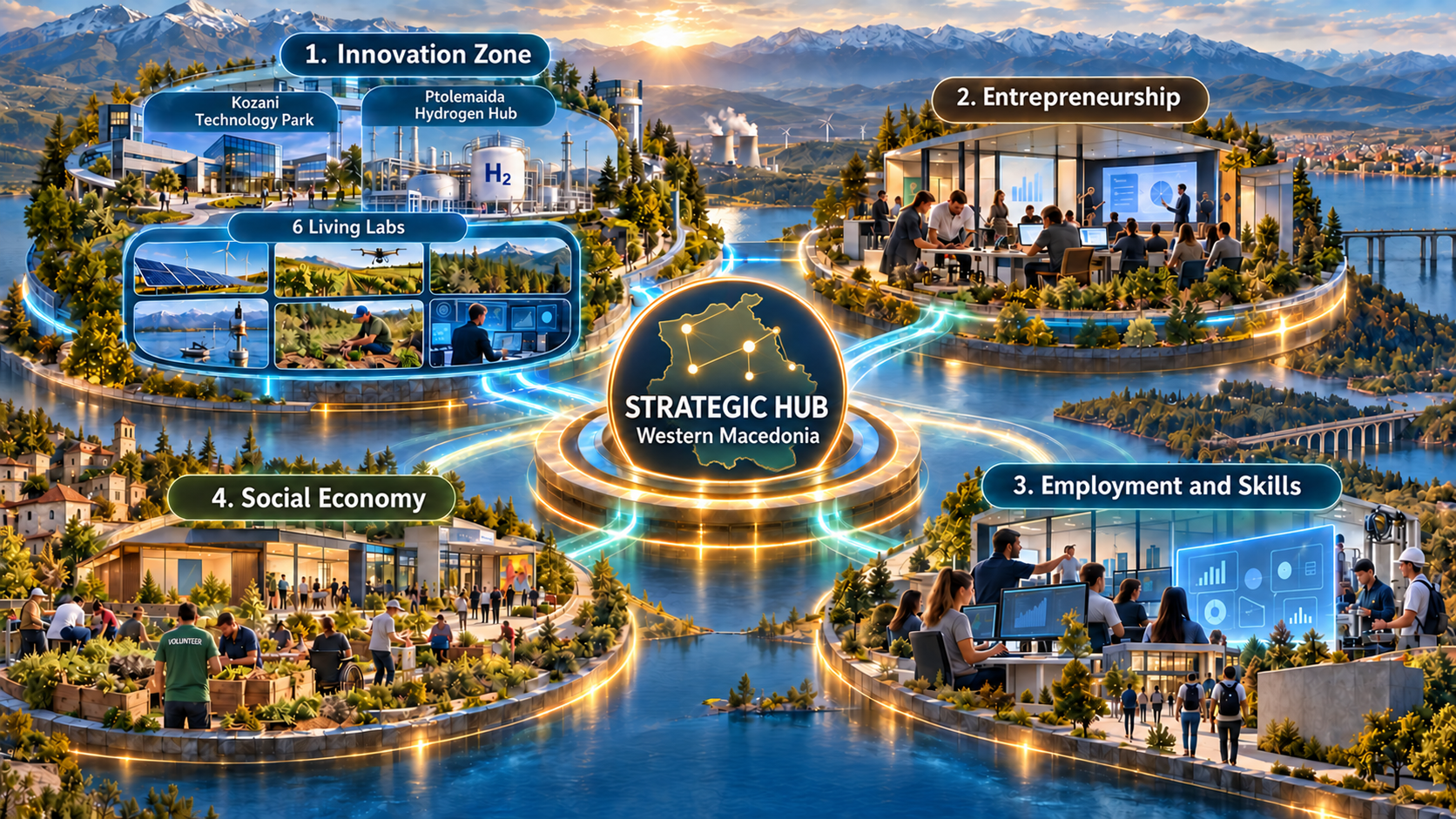

In a region undergoing economic transformation and a transition in its production base, innovation gains practical value when it connects scientific knowledge with the needs of businesses, citizens and society. At the initiative of the Region of Western Macedonia, we at the Regional Development Fund, the Region's legal entity governed by private law, are working to prepare and gradually implement the Living Labs as a key component of the Western Macedonia Strategic Hub.
We are working to turn this plan into functioning infrastructure, services and partnerships. We are currently in the preparation phase. Progress requires collaboration among all participating institutions and contributions from everyone who can share knowledge, experience, proposals and informed views.
The international approach to regions in industrial transition emphasises economic diversification, skills, entrepreneurship and experimentation involving local stakeholders. We place our own efforts to advance applied regional innovation within this framework, combining approaches tailored to the region with collaborative governance.1
The research rationale for Living Labs
Living Labs are open innovation ecosystems in which researchers, businesses, public bodies and citizens jointly develop and test solutions in real conditions. Co-creation brings users into design, experimentation and evaluation. This collaboration reflects the Quadruple Helix model.2
The research literature highlights the multidisciplinary nature of Living Labs and identifies challenges in governance, user recruitment, sustainability and scaling. For us, these become design requirements: a clearly defined problem, active participation, assigned responsibilities and evaluation supported by evidence.3
Our approach draws on Regional Innovation Systems, which highlight the importance of institutional connections and learning through interaction. We seek to strengthen the ability of businesses and local organisations to use knowledge, test technologies and make decisions informed by stronger evidence.4
The Strategic Hub: planning a shared effort
Through the Strategic Hub, we aim to build an open system of collaboration reaching almost all of Western Macedonia's institutions and organisations, as well as the wider community. Institutions, businesses, professionals, researchers, community groups and interested citizens can contribute their knowledge, experience, expertise, networks and views. Bringing these capabilities together in a fully connected pathway of support is a goal we are working towards gradually.
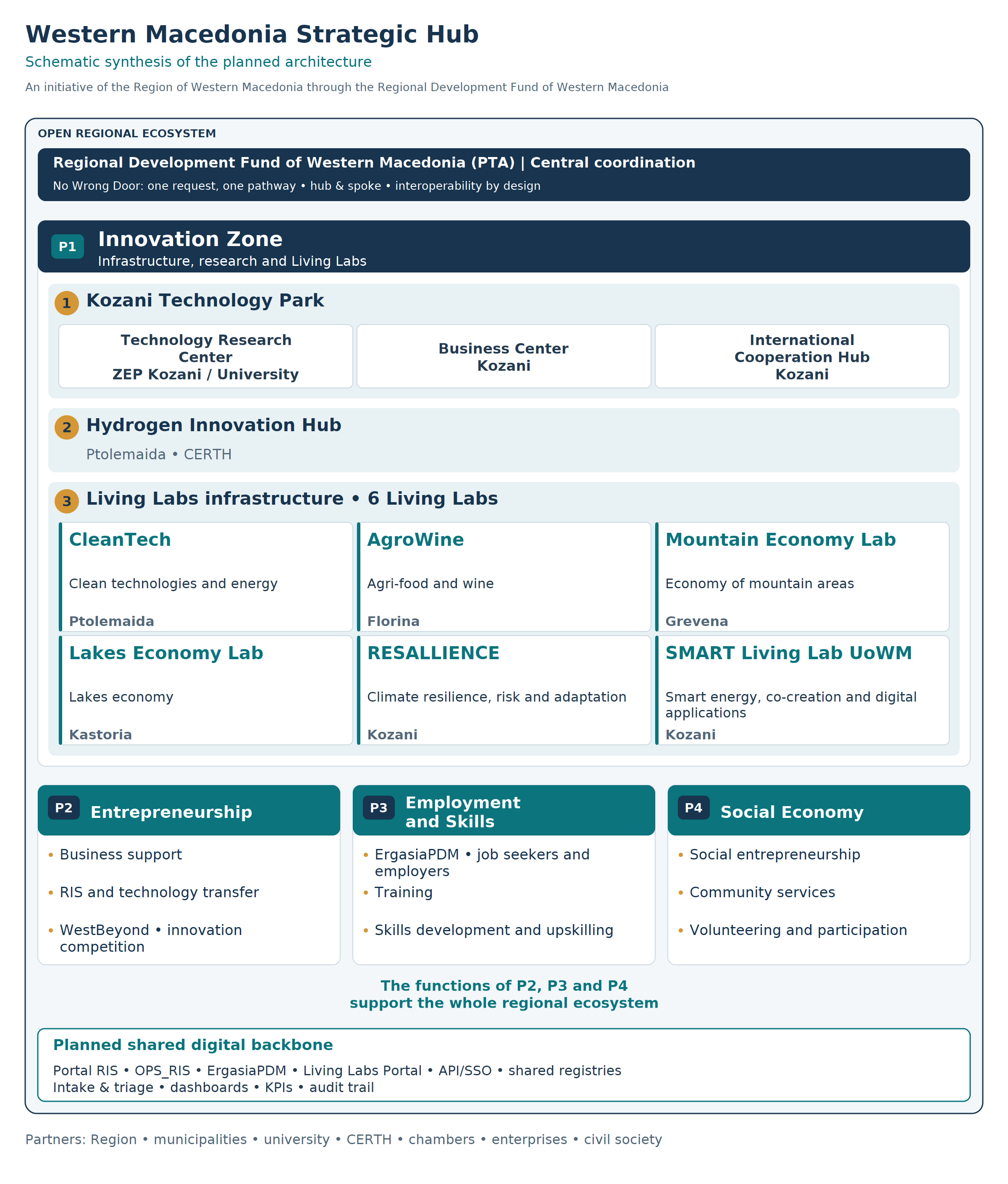
Our plan for the Strategic Hub encompasses all four pillars of regional planning: the Innovation Zone and Living Labs, entrepreneurship, employment and skills, and the social economy. Within the planning of the first pillar, the Innovation Zone comprises three planned levels: first, the Technology Park of Kozani; second, the Hydrogen Hub at Ptolemaida; and third, the six Living Labs. Through the Region's initiative, we seek to organise the connection between the four pillars, with the Regional Development Fund (RDF) providing strategic coordination and the individual subsystems serving as specialised structures for implementation.5
The No Wrong Door principle expresses our goal: wherever a request first enters the system, it should reach the appropriate service, with shared tracking and continuity of support. We seek interoperable subsystems with clear roles, adequate services and the ability to work together, so that citizens, businesses and society can receive integrated support.
Through the planned hub & spoke architecture, comprising a central hub and thematic or territorial spokes, we seek to connect central coordination with the nodes responsible for implementation. As the project owner, the RDF is responsible for overall planning and central coordination; the partner organisations retain responsibility for their own subprojects. Collaboration, knowledge transfer and access to specialised services are core functions of innovation intermediaries.6
The planned cooperation among ten organisations
Within the specific framework of the Living Labs and Innovation Zone project, the planned cooperation provides for the participation of ten organisations:7
- Regional Development Fund of Western Macedonia.
- University of Western Macedonia, through its Special Account for Research Funds.
- Centre for Research and Technology Hellas (CERTH).
- Chamber of Kozani.
- Chamber of Florina.
- Chamber of Kastoria.
- Chamber of Grevena.
- Technical Chamber of Greece / Western Macedonia Section.
- Geotechnical Chamber of Greece / Western Macedonia Branch.
- Economic Chamber of Greece / 5th Regional Department of Western Macedonia.
Through this planned partnership, we seek to connect regional development planning with research, technology, and professional and business experience. The planned cooperation among ten organisations is a specific part of this effort. Building and connecting the wider Strategic Hub requires contributions from the entire regional ecosystem.
Six laboratories and preparations for implementation
The plan includes six laboratories with complementary areas of work:
- CleanTech Living Lab (Living Lab for Clean Technologies and Energy).
- AgroWine Living Lab (Living Lab for Agrifood and Wine).
- Mountain Economy Lab (Living Lab for Mountain Areas).
- Lakes Economy Lab (Living Lab for Lakes).
- RESALLIENCE Living Lab (Living Lab for Climate Resilience, Risk Management and Adaptation).
- SMART Living Lab UoWM (the University of Western Macedonia's Living Lab for Smart Energy, Co-creation and Digital Applications).
We envisage new interventions alongside the use and upgrading of the existing SMART laboratory. Illustrative activities in the Action Plan include urban digital twins in the clean technologies laboratory, smart agriculture in the agrifood and wine laboratory, and green technologies for restoring former lignite mining land in the resilience laboratory.
We are currently preparing launch meetings for each laboratory, with common guidance and a specific focus for each. We aim to agree operational responsibilities, identify equipment and service requirements, and select the first pilot applications on the basis of the Action Plan, the Technical Project Fiche and the project approval decision. The next step we seek to take is phased implementation, subject to the required approvals and procedures. Progress requires collaboration among all participants, clear responsibilities and opportunities for the wider community to contribute.8
Existing initiatives and tools that we seek to connect
Through the Strategic Hub, we aim to connect the entire regional ecosystem with the available support structures, services and tools. This connection addresses the needs of citizens, businesses and organisations across all four pillars. The innovation competition and the search for employment are two illustrative areas of this wider effort.
WestBeyond (Western Macedonia Innovation and Entrepreneurship Competition and Two-Day Event) is a joint initiative of the RDF and the University of Western Macedonia, through its Technology Transfer and Innovation Unit, to showcase ideas and connect research with the market. The 2026 edition provides for submissions by 1 November and the two-day event on 10 and 11 December. It is an existing example of collaboration whose experience we seek to draw on as we work to connect the wider ecosystem.9
Similarly, ErgasiaPDM (Western Macedonia's digital portal for jobs and employment) is an RDF tool for matching people seeking work with businesses offering vacancies. We can use it within an integrated approach to employment support, connecting the needs of the regional economy with the skills of its workforce.10
Planning evaluation and drawing on European experience
Success needs to be evaluated in terms of the practical value of applications and the use of knowledge. Alongside outputs, such as infrastructure, services and trials, we want to track outcomes: the adoption of solutions, technical and economic feasibility, environmental performance where applicable, and the ability to sustain operations.
For each pilot application, we aim to define the problem, the participants, the initial conditions and the evaluation criteria. Comparing conditions before and after a trial will need to take account of the context and the factors affecting its results.
From the preparation phase and throughout phased implementation, we seek to incorporate experience from European examples with documented applications. Agrotopia, a Living Lab for greenhouse and urban horticulture in Belgium, connects growers, researchers and technology providers to develop, test and demonstrate solutions together.11 The completed Horizon 2020 project UNaLab, which developed urban Living Labs for nature-based solutions, produced methods for citizen participation, evaluation and the transfer of experience.12
An open invitation to contribute to implementation
We seek to open a dialogue with European Living Labs, research teams, businesses and regional development organisations. We are open to exchanging expertise, learning visits, the joint design of pilot applications and joint submissions to relevant calls.
One illustrative area is the Horizon Europe Excellence Hubs, which focus on strengthening regional innovation by connecting research, businesses, public bodies and civil society.13 We are also interested in other areas of cooperation, with the shared aim of improving the systems that provide practical support for innovation and entrepreneurship.
Our invitation extends to everyone who can contribute knowledge, experience, proposals and informed views. The needs and perspectives of citizens and users are essential to designing useful applications. For institutional information, available tools and expressions of interest in cooperation, interested parties can visit the official Strategic Hub page and get in touch using the Regional Development Fund's official contact details, indicating their area of interest, experience and proposed contribution. We seek to develop partnerships that will turn knowledge and networks into adequate, interoperable services with practical value for citizens, businesses and society. Implementation is the shared effort ahead of us, and it needs the participation of everyone who can contribute.
Endnotes and sources
- OECD (Organisation for Economic Co-operation and Development), 2023. Regions in Industrial Transition 2023: New Approaches to Persistent Problems. DOI: 10.1787/5604c2ab-en. ↩
- ENoLL (European Network of Living Labs). Definition of Living Labs and the Quadruple Helix model. ↩
- Hossain, M., Leminen, S., & Westerlund, M., 2019. A systematic review of living lab literature. Journal of Cleaner Production, 213, 976-988. DOI: 10.1016/j.jclepro.2018.12.257. ↩
- Cooke, P., 1992. Regional innovation systems: Competitive regulation in the new Europe. Geoforum, 23(3), 365-382. DOI: 10.1016/0016-7185(92)90048-9. ↩
- Regional Development Fund of Western Macedonia. Official presentation of the Strategic Hub, its four pillars and the integrated pathway of support. ↩
- Sanz, L., Klofsten, M., Van Dinteren, J., Jansen, P., Battiston, A., & Fazio, A., 2023. A Taxonomy of Organised Innovation Spaces. Joint Research Centre of the European Commission (JRC), JRC134965. DOI: 10.2760/628200. ↩
- Region of Western Macedonia, 24 August 2026. Official announcement of the project's approval and presentation of the ten organisations and six Living Labs. ↩
- Funding for the Living Labs and the Innovation Zone. The project "Development and Operation of Living Labs and the Innovation Zone of Western Macedonia", MIS (Integrated Information System code) 6050844, was approved in August 2026 under the "Just Development Transition 2021-2027" Programme within Greece's 2021-2027 Partnership Agreement (ESPA). It is co-financed by the European Union through the Just Transition Fund and by national resources. The total public expenditure of EUR 7 million covers the entire Living Labs and Innovation Zone project. Just Development Transition Special Authority (EYDAM), 21 August 2026. Approval decision for MIS 6050844, reference no. 134266, online publication identifier (ADA) available in the linked decision. ↩
- WestBeyond (Innovation and Entrepreneurship Competition and Two-Day Event). Official event website and participation information for the 2026 edition. ↩
- Region of Western Macedonia, 1 November 2024. Official presentation of ErgasiaPDM and the RDF's responsibility for its operation. ↩
- ENoLL (European Network of Living Labs). Agrotopia Living Lab, Inagro, Belgium. ↩
- UNaLab (urban Living Labs project for nature-based solutions). Official presentation of the completed Horizon 2020 project, 2017-2022. ↩
- European Research Executive Agency. Excellence Hubs, Horizon Europe. ↩