

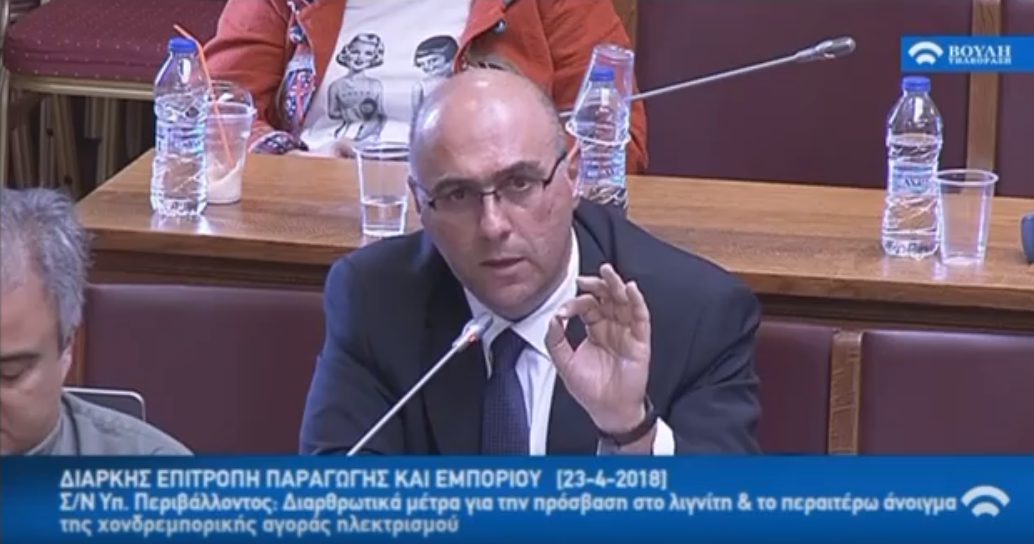
 The following video is from my positioning as President of the Technical Chamber of Greece – Western Macedonia Section (TEE/TDM) at the meeting of the Standing Committee on Production and Trade of the Hellenic Parliament [23.04.18] regarding the Draft Law of the Ministry of Environment and Energy concerning the bill ‘Structural measures for access to lignite & the further opening of the wholesale electricity market’, where the views of the bodies of Western Macedonia and Arcadia were heard [video and written positioning included]:
Ladies and gentlemen,
For many decades, and peaking in 2002, the extraction and combustion of lignite shaped approximately 30% of the Gross Value Added (GVA) at the level of Western Macedonia, whereas in the year 2014 this percentage rose to 42%.
At first reading, and taking into account the escalating contraction of lignite activity in Western Macedonia, the finding in question appears to stand in direct contradiction to what is logically expected. However, on second reading, given that since 2009 there has been a gradual decline in the total GDP of Western Macedonia, with a parallel contraction of all productive sectors at a regional level, it emerges that the lignite industry is becoming increasingly dominant in the local economy.
The above findings, among others, emerge from the recent study by the Technical Chamber of Greece – Western Macedonia Section (TEE/TDM) entitled: Update of the study ‘Estimation of the transition cost of Western Macedonia to a regime of low lignite production’ - Valuation of the contribution of economic sectors to the productive model of Western Macedonia, with an emphasis on the impact of the lignite industry.
According to the findings of the study, the following general conclusions emerge:
- Western Macedonia entered conditions of economic recession in 2006, well before the onset of the national economic crisis (2009), while the effects of the crisis exhibited milder characteristics compared to the rest of Greece. A fact which is related to the high levels of monoculture centred around the Public Power Corporation (PPC S.A.) and the strong dependence of the local labour market on the lignite industry
- At the level of Western Macedonia, the income multiplier generated by the lignite industry is 2.6.
- At the Regional level, there are no dynamic productive sectors which could cumulatively, at least in the foreseeable future, substitute the declining lignite activity, both in terms of employment and in terms of Gross Value Added.
- From the year 2004 to date, more than 10,000 direct and indirect jobs have been lost in the lignite industry, whilst over the next fifteen years 14,500 will have been lost, namely 70% of the jobs that existed in 2004.
Based on the above conclusions, it becomes clear that unless large-scale developmental actions with a strong index of employment support are initiated immediately, there will ensue severe deindustrialisation, the loss of the energy character of the region, and a risk of destabilisation of the productive fabric, with difficulty in revitalising the local economy.
Given these facts, the formulation of a New Deal for the utilisation of lignite in high value-added technologies with a low environmental footprint constitutes an inescapable necessity. Initiating in parallel a multi-year plan of developmental strategy, with an emphasis on sectors that can acquire dynamic characteristics in terms of indices for production, employment, and income, and can spark the activation of local small and medium-scale satellite enterprises.
Regarding the bill being submitted, we confine ourselves to the question of ‘public or private’, instead of the correct, modern question in terms of realism: ‘What is the influence on employment of the bill being submitted, and its impacts on the lignite regions?’
In 2014, prior to the bill for the ‘Small PPC’, the TEE made a public intervention on the issue in question, and we emphasised, among other things:
“…In practical terms, Western Macedonia took on the responsibility and the price of supplying the country with secure, logistically, and economically competitive electrical energy, on a shared journey with a large and reliable Corporation, with a distinctly Public Character.
The consolidation of a relationship of trust between the society of Western Macedonia and the Public PPC supported the most important industrialisation endeavour of Greece and the creation of the largest lignite centre in South-Eastern Europe. This relationship of trust mitigated the high regional risk that Western Macedonia undertook, contributing simultaneously to the management of the multiple impacts of the lignite activity on the urban and natural environment.
In essence, Western Macedonia supported the developmental trajectory of the country with its mineral wealth, paying the environmental and social price, but firmly believing that, from the opening of the first lignite mine until the closure of the very last power generation unit, it would have opposite it a strong and reliable corporation of non-negotiable public character…
…Consequently, the relevant bill regarding the creation of the ‘Small PPC’ should record and define clearly and distinctly the entirety of the obligations and commitments assigned to the prospective buyers, in a manner that protects the local communities and safeguards the public interest.”
It is noted that with these positions (as also emerges from the minutes of Parliament) the then opposition and current government voted against the bill for the Small PPC brought forward by the previous government and current opposition, remarking inter alia that they did not take into account the positions of the TEE.
Due to the minimal time available, I would like to conclude by putting to you the following:
- The region is already in a gradual transition. Western Macedonia is a pilot region in the European Commission’s flagship initiative for the CoalRegionsinTransitionPlatform, which is the support in the transition processes of regions heavily dependent on the coal industry towards a new sustainable and developmental model, as well as the development of new, innovative technologies. Our Region participated on 26–27 February in the first technical meeting at a European level in Brussels, and Technical Support has already been requested—a fact that is known to the Ministry of Environment and Energy (YPEN)—regarding the respective procedures, the agency, and the funding possibilities.
- This bill must provide not only for the preservation of the new Local Development Resource, but also reflect the obligations / commitments of the new companies to the local community; and above all, it must highlight the essence of the problem of securing capital so that investments can take place and the declining trajectory of the lignite regions can be halted, and obviously that of the energy heart of Western Macedonia. The bill should answer to the contemporary challenges of a new energy planning that will ensure the development of the regions where the lignite industry is active.
There is a need for planning, continuity, consistency, and the scientific workforce is here to assist…
Dimitris Mavromatidis
President of the Steering Committee of the Technical Chamber of Greece – Western Macedonia Section (TEE/TDM)