
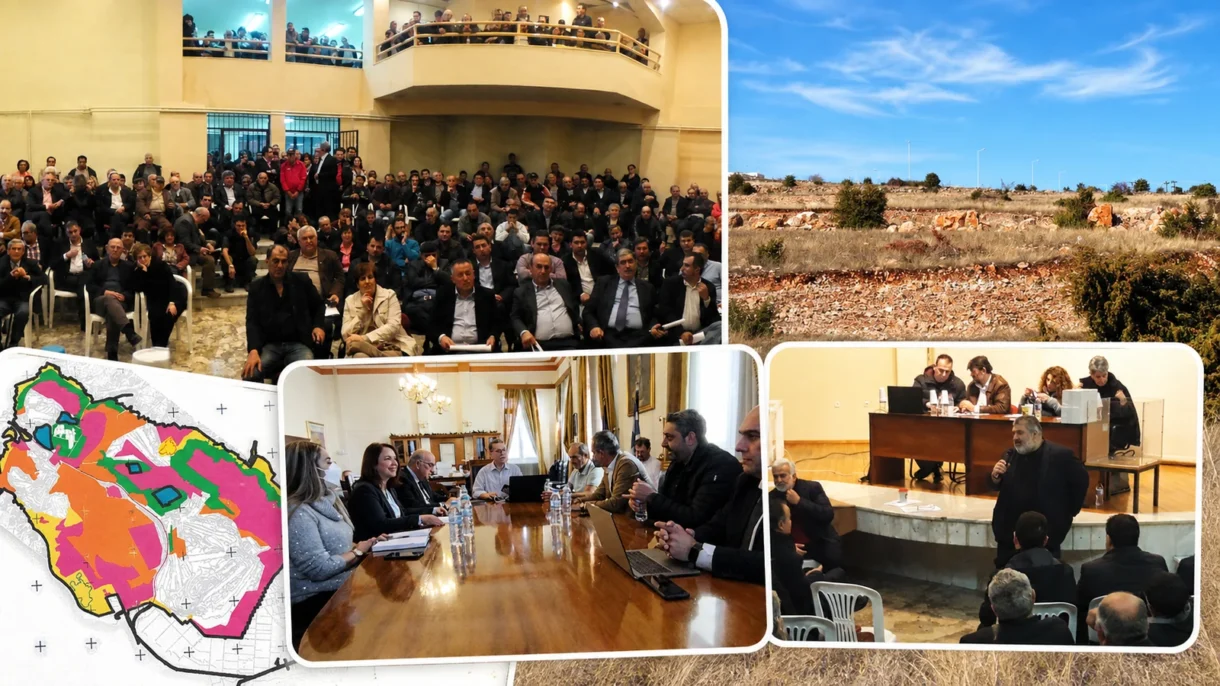

One sheet of paper in the archive deserves to be read again and again. It records a vote held on 14 September 2008. Of 826 participants, 633 selected the new site of their village — “South of the ZEP”. A village voted to relocate: not yet on the ground, but already present in collective resolve.
From personal intervention to documented evidence
Why I am publishing the Pontokomi dossier
This post offers a personal reading of the journey. The accompanying dossier brings together, in chronological order, the decisions, Government Gazette acts, public interventions and archival material.
I am not publishing the dossier simply to accumulate documents. I am publishing it because, in a case spanning almost two decades, public memory needs evidence: so that residents, researchers and decision-makers can see what was decided, what was implemented and what remains unresolved.
- Timeline
- Decisions & Gazette acts
- Primary sources
- Archival material
Open the full Pontokomi dossier →
2007 to the present · A historical record that remains open and is updated as new evidence becomes available.
For me, this sheet is more than a vote count. It condenses a community’s effort not to accept passively the consequences of a decision that was transforming its place and way of life, but to participate in defining its own future.
The decisive starting point can now be stated with exact dates. On 13 January 2007, the Environmental Impact Assessment for the South-West Field was released for a thirty-day consultation period without providing for the relocation of Pontokomi. On 12 February 2007, the issue was introduced as an urgent item before the Dimitrios Ypsilantis Municipal Council; the Council decided to submit an objection and forwarded its position to the Kozani Prefectural Council. Between 14 and 16 February, the Prefectural Council, meeting in Pontokomi, returned the assessment through unanimous Decision 25/2007 and expressly called for relocation and protective measures. On 26 February, an extraordinary Municipal Council meeting in Pontokomi unanimously approved proposals for the necessary studies, institutional coordination and next steps. The complete evidence and sources are available in the dossier timeline.
Few moments of collective decision in Western Macedonia are as clear. Faced with the prospect of relocation, the community sought to define the terms under which it would take place: through preliminary studies, criteria, public assemblies, mobilisations and successive decisions by representative bodies. The choice of the site south of ZEP was not an isolated vote; it was the outcome of a process of information, deliberation and collective responsibility. Two archival texts illuminate the next stage: the legal questions submitted to ANKO on 24 October 2008, concerning property, infrastructure and funding instruments, and the public statement of 28 December 2009 during the visit by PPC’s Chairman, calling for comprehensive expropriation, legislative safeguards and timely relocation.
The rest is best told by the record itself: a memorandum in 2010, expropriation in 2011, an approved town plan in 2016, plot allocation and title deeds, followed by years in which essential infrastructure and the high-voltage transmission lines remained unresolved. In 2022, local and regional representative bodies requested that no resident be required to leave before the new settlement became genuinely habitable—a position that appears paradoxical only when separated from its institutional history and the delays that had already accumulated.
My own reading, after almost twenty years of engagement with this dossier, is clear: Government Gazette acts, institutional decisions and plans establish the process, but they do not complete it. The true success of a relocation is not measured when a town plan is approved or a title deed is issued. It is measured when the new place has the infrastructure, safety and conditions required to become a living and sustainable community. That is why this historical record remains open to the present: not to allocate praise or blame retrospectively, but to help complete what the community itself pursued with persistence, evidence and collective resolve.
Note: a personal reading of the documented path of the case, from 2007 to the present.